
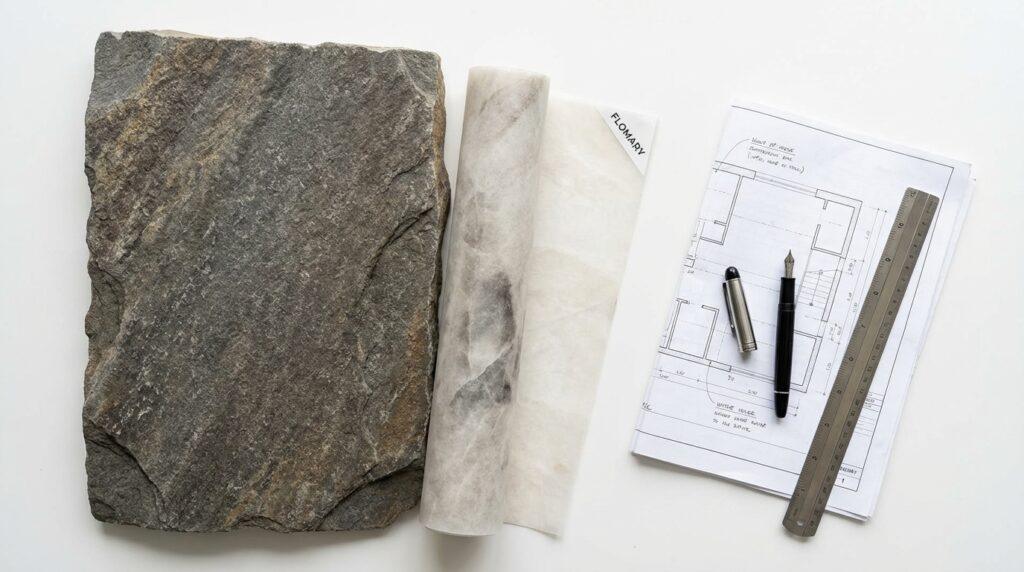
Stone Veneer vs. Natural Stone: The ROI Guide for Developers and Architects (2026)
In the competitive world of modern real estate development, every decision must pass through two filters: aesthetics and return on investment (ROI). For a project to stand out in 2026, it must offer a premium natural feel without compromising the timeline or the budget.
This is where the debate between natural full-thickness stone and engineered stone veneer becomes critical. For developers, the choice is no longer just about the look—it’s about the financial performance of the asset. At Flomary Group, we’ve analyzed over 500 global projects to bring you this definitive ROI guide for 2026.

1. The “Hidden” Cost of Traditional Natural Stone
While natural stone slabs offer undeniable beauty, their ROI is often undermined by hidden costs that developers don’t realize until the project is underway:
- Structural Reinforcement: Heavy stone slabs often require reinforced footings, massive lintels, and specialized mechanical anchors. These “behind-the-wall” costs can add 15-25% to the total wall expense.
- High Labor Specialized Requirements: A master stonemason is expensive and hard to find. The labor cost for full-thickness stone is consistently 2x to 3x higher than for veneer.
- Slow Project Timelines: Stone masonry is slow. In a world where every week of construction delay costs thousands in interest and lost revenue, the speed of installation is a massive ROI driver.
2. Flexible Stone Veneer: The “Value Engineering” Champion
Value engineering doesn’t mean “cheaper”—it means “smarter.” Flexible stone veneer delivers the exact same visual and tactile result as full stone, but with a vastly superior ROI profile.
Logistics: A 90% Savings
Traditional stone is heavy and expensive to ship. Flomary’s flexible stone veneer is 1.5-2kg per square meter. A single shipment can carry enough material to clad an entire apartment block, reducing your shipping costs by up to 90% and lowering the project’s carbon footprint—a key metric for LEED certification in 2026.
3. Calculating the Total Landed Cost (TLC)
Let’s look at the numbers for a typical 1,000 square meter exterior cladding project in 2026:
| Expense Category | Full-Thickness Stone | Flomary Flexible Stone |
|---|---|---|
| Material Cost | $65,000 | $45,000 |
| Shipping & Handling | $12,000 | $1,500 |
| Structural Prep | $15,000 | $0 |
| Labor (Installation) | $50,000 | $18,000 |
| TOTAL COST | $142,000 | $64,500 |
The Result: By specifying flexible stone veneer, the developer saves over $75,000 on a single project while maintaining a 100% natural stone aesthetic. That capital can be reallocated to premium fixtures or landscaping, further driving the property’s value.
4. Sustainability and ESG Metrics
In 2026, developers are increasingly judged on their ESG (Environmental, Social, and Governance) performance. Full stone quarrying is energy-intensive and wasteful. Our thin-cut manufacturing process produces 10x more coverage from the same amount of raw stone, making it a far more sustainable choice for green-certified buildings.
5. Why Leading Architects are Specifying Flomary
Beyond the budget, architects choose Flomary for the design freedom. Our material can wrap around curves and columns that traditional stone simply cannot. This allows for more daring, iconic designs that command higher rental yields and sale prices.
Project Consultation & Technical Support
If you’re a developer or architect planning a project for 2026, Flomary Group provides full technical support, from CAD drawings to on-site installation guidance.
Contact: Ryan Wang
Email: info@flomary.cn
WhatsApp: +86 159 2840 6067
WeChat: +86 185 0821 1865
Address: Xijiagou, Daying Industrial Park, Suining, Sichuan, China
ROI & Technical FAQ
Does stone veneer have the same resale value as natural stone?
Yes. In 2026, appraisers value properties based on the quality of the finish and the material’s durability. Since Flomary products use genuine natural stone, the property value is treated exactly the same as full-thickness masonry.
How does it perform in seismic zones?
Because it is lightweight and flexible, our stone veneer performs exceptionally well in earthquake-prone regions compared to rigid, heavy stone panels which are prone to cracking and falling during seismic activity.
Can it be used for high-rise projects?
Absolutely. Its lightweight profile makes it an ideal choice for high-rise facades where wind load and structural weight are the primary engineering concerns.


